
on the road in Pakistan...
"Wow, you are from New Zealand? Your cricket team is not so flash!" We have barely arrived in Pakistan and already, cricket is everywhere, a national pride and passion. Yvoine, who has refused for years to understand this sport (one of the only ones in fact...) even starts to learn the rules, admiring all the Pakis playing on the street...
60km after the border with India, we arrive in Lahore, in the pakistani Punjab region. Lahore was the old capital city of Punjab when India and Pakistan were one country under the English rule. Almost immediately as we get to Lahore, we go on our "espresso hunt", an activity that has become regular and a bit of a ritual everytime we get to a major city. As we are walking along yet another street, we see a small sign above our heads stating: "CRAVE, coffeeshop and bakery". We don't need anymore than that. CRAVE? The little cafe where we have shared many and one coffees with our cycling friends from Sydney, after many and one cycling sessions? For our friends back in OZ, we have got to check it out.
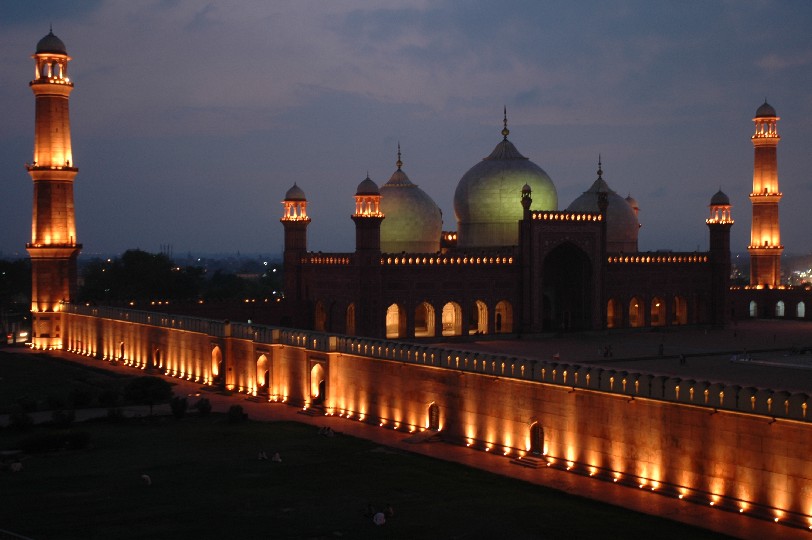
It looks like we made the right decision. We find there a beautiful, brand new espresso machine... That is a good sign. The cafe, however, has only been opened a few weeks, and the staff does not really know how to use the machine. Never mind, Mike changes hats yet again and starts giving lessons in coffee making: from short to long black, machiatto, cappuccino... Momin, the owner, and his barrista take notes, seriously, carefully, full of attention. We soon start a new friendship with Momin, a young Paki (26 years of age) who finished his studies in interior design a few months ago and has just started this new venture. He invites us to dinner the following night, together with his cousin Sohail. From the terrace of a restaurant in the old town of Lahore, we admire, in the cool of the night, the magnificent mosque all lit up in the background. We discover a country tempted by modernity but still so ancred in traditions at the same time. At first sight, Momin seems so close to us, so similar to us. We can relate to his projects, his tastes, his desires. He has set up his own business. He likes architecture and design, good music and good coffee. He dresses like we would dress if we weren't riding bikes (!). He enjoys cinema and photography. Etc... But as we discuss, another reality takes shape. Momin has been engaged for 3 years now, to Sohail's sister. His parents remind him constantly that it is now time for him to marry. But Momin is not so keen. To start with, he has not chosen his wife. And even if he respects her, he does not want to go into this arranged marriage (most of the marriages in Pakistan are arranged). On top of that, getting married here means having 1 child in the year, and 4 in the next 6 years... He feels like he is stuck in the corner. Family is too important for him to be able to say no to his father. So he keeps pushing back the wedding date, again and again... In Pakistan, it is practically always the mother who chooses her daughter in law. And when our unbelieving voices and faces ask if couples get on well in Pakistan, the answer comes with a big smile: "of course they get on well, it is the way it is here". Indeed, what we discover in the next few days in Pakistan is that there cannot be any couple problems. The man is all mighty. The woman an object. And there is very little relationship between men and women. Or at least, not in the way we consider it back home... Momin asks us if our marriage is a love mariage? To which we answer positively... We understand a bit later that a love marriage in Pakistan, as opposed to an arranged marriage, is a marriage when the man meets his future wife before the wedding day...
In Lahore, we fix our bikes, change a few parts that show signs of fatigue after 10000 km. We then get back on the road, heading south first, then west. Our Pakistani road is made of all those special moments that truely make our trip: so many offers to share a cup of tea, so many "a salam aleykoum!" and chapatis shared along the road. We sometimes have to say no, if we want to one day leave this country! "Be our guests" they say, and they insist on having us stay at their place for a night or more... A teacher waves us down, gives us peaches and asks us to come and say hello to his students. The owner of a side road restaurant sits under a tree with us, sharing a few chapatis and some tea with us, telling us about his projects to expand his restaurant. Impossible to pay. Quite often, impossible also to refuse. Our bodies live for these chais, these smiles and these never ending conversations...
As we are looking for a place to sleep in Mian Chunnan, a small town on the road to Quetta, a Pakistani on a motorbike comes to see us (so far, nothing extraordinary): "come to our home, my father is a great cyclist, you are welcome!" Intrigued, but more to the point excited by the idea of meeting a Paki cyclist, we follow the motorbike on the small bumpy back roads of the town. And indeed, we finally arrive to another world. Dr Mirza, a cyclist, a homeopath and sometimes even a philosopher, is waiting for us, a small prayer speedo in his hand (at every prayer, he pushes a small switch on the side that adds one prayer to the speedo: he is up to 780000 prayers when we get there, he is over 1 million when we leave 36 hours later). "Welcome, welcome to our home. Cyclists are all part of one same great family. I am a member of it, and so are you!"
What a surprise to meet Dr Mirza and his family. We are first somewhat taken aback when he tells us, from the top of his voice, and with great big hand gestures to make sure we are not missing one bit, that he raced for Pakistan at the Olympic Games in Rome and Tokyo. He also participated in (and finished) the Tour de France in 63! But above all, he cycletoured around the world for 7 years, in the 50s. At the time, so many doors opened for him that eversince, his door has been opened too. Very quickly, we realise we are going to have to take a rest day to share a bit more time with his family. An opportunity for Dr Mirza to get his bikes out after so many years: from under the beds, inside big metal boxes or behind cardboard boxes come out, in parts, Dr Mirza's 7 bikes, his beloved treasures. His eyes are so bright. He looks at his bikes, and at us. He loves his bikes, he loves all the bikes. As he tells us, they are all his life! At 82 years of age, the doctor is surprisingly strong and fit. He learnt homeopathy in Germany in the 60s, and he has been practising in Pakistan eversince. One of his sons is now also a homeopath doctor. On the walls of the house, one can read the messages written with a black marker pen, to remind the doctor of a few basics of homeopathy... A little bit of this if the symptoms are such... And even, in a corner, the message from a patient: "Doctor, sore liver, came here and waited, but you never came, here is my address, come and see me!" All these messages are written on the sidewalls of the foyer, in english, along the traditional welcome or prayer phrases written in arabic. We share many and one meals with the doctor and his family, his son Guddu and his friends. All want us to go and say hi to their respective families. Which means more tea to drink and more food to eat! Most of the time, Mike stays in a front room - the guest room - while Yvoine gets taken through the house to meet the women: in the kitchen in the back of the house...
We get back on the road very early the next day, followed by Dr Mirza and one of his sons in a car. After 45 minutes, they turn around and let us cycle on our own... Only to be back half an hour later with our breakfast! That we share with them, one last time, before heading into the Balochistan mountains, waiting for us to the west. We don't have to cycle for long to discover arid landscapes and our first camels! We are indeed getting closer to the desert.
We are happy to be back in the mountains as we start our climb to Fort Munro, 1700m above sea level. We also find ourselves again on some very crappy roads, as the Pakis are in the process of widening the road, blasting the mountain away... In the meantime, we get our share of dust, holes, bumps and other delights! That seem so familiar now! Here again, we are invited to spend the night at Ahmed's, the owner of a restaurant in Fort Munro. Sitting on his roof, we watch the sunset and a magnificent show of lightnings as a thunderstorm makes its way towards us. In this country where alcohol is supposedly banned, Ahmed - like so many before him - offers us the infamous Paki whisky, that apparently gets you drunk but never sick...?
In the mountains, the temperature drops a bit. We keep starting our days just before sunrise though, accompanied by the songs of the muezzins or the donkeys's cries. One morning, as we are heading off at 4am, we don't get to ride for more than 5 minutes when we get stopped by the police. They are in cars and on motorbikes, with their lights and sirens seriously contrasting with the silence and dark of the night. Forced to stop, they offer us tea while they go over the last organisational points of our escort! They saw us arrive the day before, waited for us all night, and are now about to escort us to Ziarat! Shame we are not allowed to take photos of the local authorities, because the photo of our 2 policemen on their motorbike, one driving, the other one his gun in hand, pointing in the air, would certainly have been worth it. Over several hundreds kilometers, our escorts relay each other, according to their administrative areas. Regularly, they go ahead to get tea and biscuits ready, or lunch, or pick us some peaches in one of the local orchards!
And so it goes, from one tea to another, from one escort to the next biscuit stop, from one chapati stop to the next "Salam Aleyk", we do eventually get to Quetta, in the centre of Balochistan. Ahead of us, 800 km of desert to get to Zahedan, our first town on the Iranian side.
//
you can see more photos by visiting the photolibrary.
