
peace messengers
"Make sure, back home, you are peace messengers..." He looks like a Michelin man - Paki version -, with a big moustache and big deep black eyes smiling but that have suddenly turned very serious. He is the manager of Multan's central post office (Central Pakistan). We are here to send a few postcards to France and New Zealand. As usual, we end up drinking tea from one office to the other, time to have a conversation or two. And like so many Pakistanis met on the road, our post office manager here deeply regrets being called a "terrorist" in the western world.
They are not entirely wrong. How many people have told us not to go to Pakistan? How many times, over the last 3 years, the long bushy black beard has been associated with muslim extremes? How often when people think islam they think terrorism? Let's not be naive however. For sure, there is a strong conservative muslim movement in Pakistan. Balochistan, north-western Pakistan, was in fact the base from where Talibans took over Afghanistan a few years ago, via Kandahar.
We discover, however, a very warm Pakistan (albeit very male... we'll come back to it). We learn again, or maybe we just learn for the first time, the meaning of words like "hospitality", or "welcome". Everywhere, we are "over-welcomed". Here some tea, there some chapatis, there again a small room or a corner in a caravanserail where we can sleep... There is no limit to these people's generosity. we have to refuse from time to time, because invitations happen every 4 kilometers! At this pace, we will never get to Iran! It is a true lesson for us, and probably for the western world in general. When we explain this to a post office agent in Quetta with whom we are sharing yet another cup of tea, he looks at us surprised and not understanding: "but this is life! to meet, build and maintain a relationship, it is what life is about! Tea is only an excuse to spend time together. But without this, without all these moments spent with colleagues, family and friends, what would life be?" When we explain to him our scheduled and timed lives back home, our appointments, our deadlines, our rushing on the streets or on the tube because we are always late, he just shakes his head...
Pakistan sends us back to September 11 and everything that has happened since. Except we are now on the other side. As always, most people we meet here just want peace. They get angry at the idea of innocent deaths. The London bombings, that take place when we are in Pakistan, bring the topic to the heart of all conversations. They suffer from being called terrorists. They regularly ask us "are we terrorists"? "What do you think of Ousamma Bin Laden? And of President Bush?" Our answers are honest although we sometimes feel like we are walking on dangerous ground. The current situation is extremely sad indeed. It puts barriers and hurdles to the knowing and meeting of others, both critical elements to peace on earth. As for terrorism, we cannot of course accept it, whether in the US, in Irak, in France or in Pakistan. Blind and innocent deaths cannot be justified. "But, are you muslims?" they keep asking. Our answer to this question is always the same: there is only one god, whether you call him/her Allah or God or something else... Reactions to our answer are unanimous: "come and drink a cup of tea with us, we are all brothers!"
One evening, as we are sitting on the floor of a small teahouse, eating naans and drinking tea, our host turns the television on. General Musharraf is talking to his advisers and key people, and through them, to the nation. His speech is partly in Urdu, partly in English. We are impressed. His message is clear and simple: let's build together a modern and open Islam. General Musharraf, who took over power in Pakistan a few years ago in a military coup, seems to be wanting to move his country forward, even if slowly... Even on the topic of women, he publically stated that he was against what is called "murder of honor" (although he has not gone as far as drawing a law against it). "Murders of honor" are a convenient excuse men find here to kill their wife, their sister, their daughter, in all impunity. 1000 times a year, they kill them for a side look at a man or too friendly a conversation with a neighbour...
Ah women! In a country so warm and so welcoming, we are however faced with a dark reality: when it comes to women... Where are they, to start with? We are cycling through a world of men... 99.99% of the time. The few women we meet, they are like tents (the litteral translation of Tchador is "tent" and indeed, seeing these few women walk around , covered from head to toe, they really look like tents. And even, when their tents are white, we are struck by a curious resemblance to the members of KKK...). Mike finds the right words at some point on the road, as a small van passes us, with bars on the windows and 6 tent-women inside: "it looks like a prison, except the eyes are smiling". After a few days, this man's world becomes claustrophobic. So we start asking more direct questions. The most creative answer we got is worth writing down: "how do you expect our women to walk on the streets? They are too many people out here. With their burka, they would not be able to go anywhere..." All this told with great seriousness. Above all, as we get to talk to more and more people, the way women are considered and treated really makes us uncomfortable - to say the least. For us who have never really been great feminists, it really makes us want to fight for the cause and rights of women around the world. Women are no more than objects here. A very useful object to give birth to sons. Most often, men just talk to Mike, absolutely ignoring Yvoine. They ask him if he has got brothers? Sons? So often, the so friendly and nice people we meet on the road proudly tell us that they have 3 sons. And the sisters? The daughters? They are surprised we bother asking...
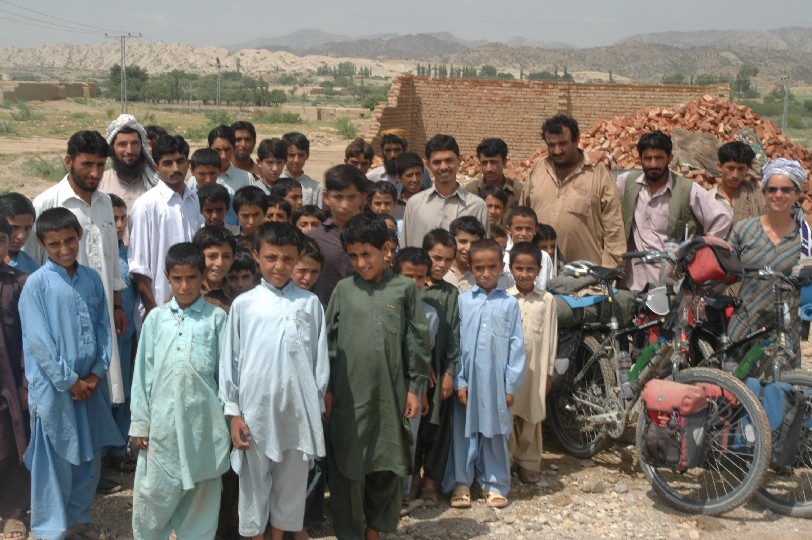
Several times, to the teachers' request, we stop at schools to talk to the kids. To the boys rather. "Where are the girls?" we ask. "O, in the mountains" we get told. Or "they sometimes go to school from the age of 5 to 12. After that, it is time to marry, have sons, inch' allah". Of course, it seems things are changing a bit in the bigger cities, like in Lahore for example. There are more women on the streets, and the tchador is a bit less of a prison. Even on the road, behaviours are not always the same. And there are quite a few Pakistanis who enjoy - or so it seems - having a conversation with Yvoine (which tells us that maybe the treatment of women is not necessarily linked to Islam and that it is not only a question of culture). But the reality on the road is more often than not very disconcerting. It remains as a cold shadow on the warm welcome we have had everywhere.
So yes, we want to be peace messengers. For the men and women of Pakistan...
//
you can see more photos by visiting the photolibrary.
